Monday, June 7, 2010

On Egypt, Part II: Adventures in Customer Service

I got up early in the morning, headed downstairs to reception and handed over a laundry bag.
- Could you get this washed for me, please?
- No problem, sir. It'll be ready this evening or tomorrow morning.
I expressed my preference for 'this evening' and went off diving. Diving was nice, we saw dolphins

I'd never seen a dolphin diving before

Some beautiful corals too

I returned to the hotel. I inquired about the state of my laundry. Frenetic usage of cell phones ensued. 'You are in room 105?' 'No...' 'You left the laundry in your room?' 'No...' More frenetic conversation in Arabic.
- [smiling broadly] Fifteen minutes, sir!
I wasn't sure what was supposed to happen in fifteen minutes, and pointed out that it seemed like he had no idea where my clothes actually were?
- [more smiling] No problem, sir, fifteen minutes! No problem.
I went off to find dinner.

[an hour passes]
- [smiling broadly] Have you found my laundry?
- No problem, sir [more frenetic cell phone conversation]
waiting...
- Yes, yes, in your room or down here?
- Doesn't matter

I give it another hour while sitting on the front deck, reading my book and chatting with Ali, my local 'fixer.' I finish, and, as a sign of good faith, head directly upstairs, instead of stopping by reception - the laundry might actually be there now, right? Of course not, back to reception. Another frenetic phone call. Why doesn't the laundry room (upstairs in the same building) have a land-line?
- Ok, ready - they'll bring it to your room.
- Ok
It's not like I actually have big plans for the night here in Hurghada, so I don't particularly need the laundry returned now, but I don't necessarily want to keep dealing with this. 15 minutes passes while I examine that thought, and a broadly-smiling 17-year old materializes outside my door with the familiar laundry bag. The price is 10 pounds (which is very good value, admittedly), I hand him over a 50 note and he runs off to get change. I check the laundry - sigh...

The smiling 17-year old returns with my change. I point out that the clothes aren't actually dry. He takes the bag, smiles some more, and promises to come back. I go back to lying on my bed, studying the universe, wondering what he's actually going to do...

Fifteen minutes later, I get another knock on the door - he's now smiling even more broadly and making vast, sweeping ironing motions with his free hand. I thank him, take the bag, and send him away. Five minutes later, as I'm hanging up my clothes (which are every bit as damp as they were fifteen minutes ago) all over my room, I conclude that the kid must have a learning disability.


This is Hurghada (I eventually decided to stay instead of taking the 14 hour bus ride to Sinai), I rather like Hurghada actually - it is only a slightly over-built under-planned resort, not a hideous neon-glazing monstrosity like Sharm el-Sheikh

The customer service, and the command of the English language, leave something to be desired though. That's not really unique to Hurghada though.

The waterfront on a nice calm day

Life Aquatic

There's a lot of little rays in the waters too

Swimmin' with the fishes


Ok, I can't resist - one more little nugget of fun in a Egyptian hotel... So, I returned to the room in the evening. I flipped on the light switch. Nothing happened. Odd - I could have sworn I had lights in here the other night? I turned on the light in the bathroom, examined the room, didn't see a light fixture. Very odd? I resumed introspection, and the waiting for the laundry. Five minutes later it hit me - that's right, I actually removed the light bulb myself the night before, prior to going to bed! Why? Well, rewinding some 22 hours...

I had just returned from the bus station, having decided that a 14 hour bus ride to Dahab would be stupid, so instead I was going to stay here in Hurghada and just dive this side of the Red Sea. The Thistlegorm wreck, the most famous dive site on the Red Sea, closer to the other side of the channel, would have to wait for another time. I brushed my teeth and turned the lights off, noting that they are using these high-tech, lower-power-consumption twisty light bulbs (pretty cool). So, I got in bed - something flashed. A few seconds later, something flashed again. What the? I studied the room for a moment - it flashed again. Weird... Pretty soon I divined that apparently, after you turn the power off, the high-tech, lower-power-consumption twisty light bulb continues to flash every few seconds here. I thought about static charges, capacitors, and college... then unscrewed the light bulb and went to sleep.

Sunday, June 6, 2010

Tomb Raider Footsteps

Lara Croft hunts for her mysterious treasure at the Angkor Wat Temple complex near Siem Reap, Cambodia. I followed in 2008. It was spectacular. Go back a little further in Hollywood tomb raider history and Harrison Ford, as Indiana Jones, goes to find the Holy Grail in the 'Canyon of the Crescent Moon,' or as the 2,000 year-old city carved out of rock is more commonly known, Petra. Which is in Jordan, just a skip and a hop, and a two hour taxi ride from the border with Israel. So, being in Tel Aviv a few days ahead of Yael's wedding, Bailey and I headed South to follow in Indiana Jones' famous foot steps. Yes, and the Crusaders, and Saladin, and the Romans too, but 'Indiana Jones and the Last Crusade' was only some 20 years ago, and it's a right now sort of world we live in!

Side note: this actually happened almost a month ago now. If you are wondering why my recent posts have involved the rather disparate locations of Jerusalem, Petra, and the Pyramids of Giza, it's because, well, I'm almost a month behind on any real blogging. Catching up...

So, Petra!

The first glimpse of the Treasury as we are making our way through the Siq, which is also known as a long canyon carved via erosion through the rocks over thousands of years. I prefer Siq.

And here's the Treasury itself, the premier of Petra's sites (and the supposed one-time home of the Holy Grail)

The site is not-so-enthusiastically guarded by the local police forces

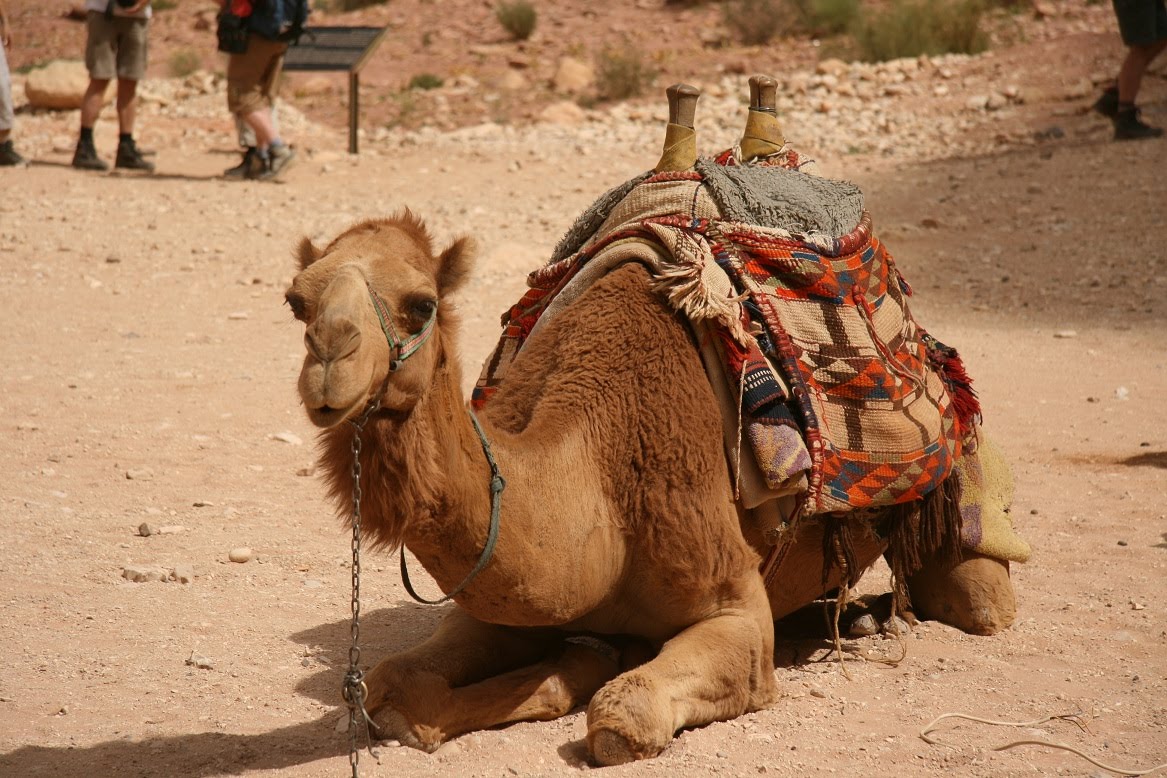
But if they slip up, the camels' got their backs!

Getting to Petra was a bit of an adventure as we had to negotiate a taxi fare immediately after crossing the border from Israel. And taxi fares aren't cheap when you have to drive for two hours, and there's no competition, so the negotiations may have been a bit contentious. Most visitors to Petra choose to skip right over the negotiations process and arrive here onboard a gigantic tour bus. We met plenty of them going into Petra in the morning - by the afternoon, they were all gone, heading back to Eilat, Jerusalem, Sharm el-Sheikh, or wherever it is the bus had brought them from. Which meant that the Treasury, above, was just about all that they got to see in Petra. Which is a shame really, as there's a lot more to it - us, having independently negotiated the taxi fare, and thus having a full days to explore the place, Bailey and I set off to climb all the little goat paths up the hills and see every last monument in the place!

Climbing along the wall

And more climbing...

Eventually we got to a lookout point high above the Treasury, presenting a spectacular view of the ancient monument

The giant Urn Tomb. Pretty much all the monuments here are actually tombs (much like the Pyramids in Egypt...) - the people's homes were more like modest and portable tents, so not much has survived

And this tomb looks a good bit like an angry face

Bailey in front of more tombs

And then the dust came...

So Day 1 ended somewhat anti-climactically, with Petra covered in a cloud of dust. I thought it actually made for some interesting pictures, but you couldn't see the monuments from more than a couple hundred meters away. Besides, we were exhausted anyway, having started hiking and climbing before nine that morning. But we did get to see most of the place, and left feeling much superior to the tour bus groups. They paid more anyway!

The second day came about, and with fresh[er] legs and distinct hopes of not getting swallowed up by any more dust clouds (our man, Mahmoud, at our hotel promised it was an uncommon occurrence), we headed back out. Having actually seen most of Petra the first day, we took a taxi to nearby Little Petra - it's sort of like the real thing, but little. And free to enter...

We found a temple. Seen here getting ready to scale the ledge to get to it.

Somewhere deeper into Little Petra, we met our would-be guide, who was ready to show us the path (spectacularly scenic path) that led to Petra proper. After some negotiation, we arrived at a price for his services that we felt wasn't entirely outrageous. So, off we went, past goats, cliffs, inspiring peaks and canyons, and often following paths that were best suited for a goat. The trek took about three hours, and the guide was worth every penny as it turned out, as we would've never found the way on our own.

I have a new-found appreciation for the goats' ability to navigate tiny little mountain paths.

Guide earning his pay by showing us the way along goat paths, often like this one. Sometimes smaller and windier...

And at the end lay our reward, the Monastery!

With the dust cloud moving in, and leg muscles complaining, the Monastery was the only major part of Petra that we had missed the day before, so the goat path entering Petra out by the fabled Monastery was an effective selling point in our prospective guide's sales pitch. Also effective, the fact that Bailey and I had only purchased single day tickets the day before, and had managed to avoid the sporadic patrols along the goat path, thus sneaking in for free on the second day.

And on that triumphant note, it was time to hop into a taxi and race back to the border in order to make it to Tel Aviv the next day in time for Yael's wedding. Made it - no problem!

On Egypt

Egypt, for all its ancient and mesmerizing beauty can at times be incredibly frustrating. 150 years of tourism has turned the place into a carnival of package tours, and rampant corruption has turned it into a place of tour agencies, collecting fat commissions. At the moment, I'm in Hurghada, on the West Coast of the Red Sea. I would like to go to Sinai, on the East Coast of the Red Sea. This much I know. Here's what I don't know:
- there's a ferry that runs to Sharm el-Sheikh. But I've been told by my hotel that it's not running right now. It is, however, not possible to confirm this, as the ferry operator does not have a website I could locate, and the travel agencies around town have no idea. The agencies which [supposedly] sells tickets for the ferry remains closed. Maybe that's a sign?

- IF there's no ferry, I will take the long bus ride around the Red Sea. But the bus station is on the other end of town, and nobody in town knows the bus schedules (and if they told me that they did, I wouldn't believe them anyway). My guidebook has schedules, but it's five years old, and the schedules seem to change daily, so I don't choose to put too much stock into it. I suppose I'll have to give in and take a taxi to the bus station... there's no public transport in Hurghada, obviously - everyone arrives on a package tour!

So, I'm frustrated... But the azure waters of the Red Sea are beautiful, and I do look forward to getting under those waters to go diving. And it's not as stiflingly hot here as it was inland in Luxor and Aswan!

Friday, June 4, 2010

Terre Sancta

Jerusalem... The Holy Land

Jerusalem... I've seen lots of places over the past two years, but none of them approach Jerusalem. It's hectic, yet downright transcendent; it's ancient, yet at the forefront of modern-day's politics; the people here look like they still live in the 17th century, yet each has a satellite dish on the roof. It's a city of contrasts, yet harmony, which manages to highlight both the multitude of differences and the even more numerous similarities among the people living here.

So, some of the more amazing places about Terre Sancta:

The History
Sure, lots of places have all kinds of historical significance - be it Rome, China, Egypt, or India, but none of them can compete with degree of difficulty, and significance that this piece of land, lying at the meeting point of Africa, Asia, and Europe holds. Three of the world's major religions consider it holy, and hardly an empire has existed over the past three millenia that didn't impact Jerusalem - even the far flung Chinese were connected via a terminus on the Great Silk Road. So, a few of the historical highlights:

The Church of the Holy Sepulchre

The Church of the Holy Sepulchre is only the holiest Christian site in the world. This is the spot, where, it is said, Jesus was nailed to the cross, died and rose from the dead. I'm by no means religious, nor am I really all that versed in the Bible, but certain basic bits of Christianity are inescapable in our world today, and standing on roughly the spot where Jesus Christ was nailed to the cross is pretty awesome, no matter what your thoughts on religion are. And if your thoughts are a little more devoted than mine, then you are one of the many who've been making the pilgrimage to this very spot over the past two thousand years, sullenly entering the church, and prostrating yourself on to kiss the holy ground. We witnessed the spectacle continue to this day, and I came away, well, subdued.

The Golden Cupola is the 'Dome of the Rock,' underneath it lies the rock, considered sacred by both the Jewish and Muslim faiths

The two holiest cities in Islam are Mecca and Medina, where the Prophet Mohammed lived and preached. Jerusalem, however, is next line, as it was here that Mohammed had traveled to launch himself heavenward to take his place alongside Allah. He, in fact, launched himself off of the rock, now covered by the gleaming Golden Dome above, which, as it turns out, is actually even more holy in the eyes of Judaism. According to the Jewish faith, the rock was the foundation stone of the world - it was here that God had created the Earth used to form Adam, and it was here that Abraham nearly sacrificed his own son Isaac, as a test of faith. It was also the site where King Solomon had erected the first temple (and after that has been destroyed by the Babylonians, the Second Temple followed... only to be destroyed by the Romans)

The Western, or Wailing Wall on Shabbat evening

And yet, in modern times, the Temple Mount, which houses the Dome of the Rock, is not visited by religious Jews. Instead, the holiest Jewish site is the Western, or Wailing Wall, which is, of course, here in Jerusalem too. It is, in fact, merely a retaining wall for the Temple Mount, above. But following the destruction of the Second Temple by the Romans in AD 70, the precise location of the temple was lost, and upon returning to Jerusalem, the Jews studiously avoided the Temple Mount, lest they unknowingly step on site of the Holy of Holies, the ancient inner sanctum of the temple, barred to all except high priests. Instead, they began praying at the exposed outer wall, which the divine presence had never left, according to rabbinical texts.

Immediately after the 6 day war of 1967, when Israel had recaptured Jerusalem, Moshe Dayan, the Israeli commander, handed over the Temple Mount to the city's Muslim leaders. I assume because it is a holy Muslim site, and a site that pious Jews wish to avoid anyway. These days, the access to the Wailing Wall is open to anyone 24 hours a day - it acts as an open-air synagogue. Access to the Temple Mount, on the other hand, is very restricted - men and women of any faiths can go, but only at very restricted hours and days of the week. Unfortunately, not knowing the specific restrictions, Irina and I missed out on the chance to go up to the Mount... I guess, we'll need to come back to Jerusalem again - next year in Jerusalem? (probably too soon...)

At the Church of Nativity in Bethlehem

Back to Christianity and Jesus Christ. A massive wall separates Jerusalem from the Palestinian West Bank. Just on the other side of this wall lies the town of Bethlehem. Here sits the Church of Nativity - the world's oldest continuously operating church (commissioned in AD 326) is the birthplace of Jesus. The Grotto of the Nativity here has a continuous line of men and women ready to offer their prayers to the very spot were baby Jesus was said to have been born. We snuck in from the exit to catch a glimpse of the place, but I was wary of taking pictures...

The Russian Chapel of the Ascension

Mostly, I included this photo simply because it's a beautiful golden-dome Russian Church. The Russian Orthodox Church does, however, claim, that this is the precise spot where Jesus made his ascent to heaven... Jerusalem is sort of like a capital of Christianity, so various sects, or states have their own churches and hospices in the city. Funny how the Buddhist nations all do the exact same thing in Gaya, India, the spot where Buddha had initially achieved enlightenment.

The People
Once you get past the history and arrive in the present day, the most fascinating thing about today's Jerusalem is the widely diverse people that inhabit the place. The Old City is split up into four quarters - Jewish, Arabic, Christian, and Armenian. Yes, I know, the Armenians don't seem to belong, but Armenia was apparently the first nation to adopt Christianity, and they had made a significant alliance with the Crusaders when they had come to reclaim the city in the Middle Ages... In summary, they've got a quarter, but it's small and very quiet, so, unfortunately, I don't even have any good pictures from there... But on to the fascinating, varied, emotional, and opinionated people of Jerusalem:

Jewish man praying at the Western Wall

Muslim trader in the bustling bazaar, which is the Arabic quarter of the Old City

Christian procession carrying the cross, following in Jesus' footsteps along the original fourteen stations of the Cross

Kids playing football, soccer if you like, in the neighborhoods of the Arabic quarter

Jewish boy dressed for the occasion at the Western Wall

Explaining an important point on the street

A Christian nun on the streets of Bethlehem

Muslim women in the Arab quarter

More prayers at the Western Wall

But the most amazing thing of all is that, right now, we all more or less get along. It's hard to say how long this'll last - the Arabs generally feel like they're living in a conquered state, the more liberal Jews just want to find some sort of an amicable long term resolution to the whole thing, and the orthodox Jews just want to pray and study, and they'd like to everyone else to do the same. So, it's a tenuous situation, but for now, we all seem to get along just enough for visitors to come and enjoy the place, and, in turn, be overwhelmed by it:


Like I said - tourists. A break while taking a spectacular walk along Jerusalem's ancient wall

Life goes on in the city - an orthodox wedding not far from the Western Wall. We concluded that the bride was likely Russian (after all 1 in 7 current Israelis are), so not sure how fervent she might be about the orthodox lifestyle?

And keeping the peace, the army... Not at all opposed to having tourists take pictures though...

So, that's a brief take on Jerusalem. It took me a while to get to it, but it was hard to come up with any sort of coherent way to present everything there is to be said about Jerusalem, and, in spite of everything above, there's plenty more to be said. (All historical/Biblican information courtesy of my Lonely Planet - I won't claim to be up to date on any of this stuff, but it sounds about right to me).

Tuesday, June 1, 2010

Seven!


That's right, I've finally made it to Africa, continent #7! Oh, and there's some fairly large Pyramids around here too... Heading deeper into the continent, up the Nile into the center of Egypt tonight.