Saturday, July 11, 2009

Getting warmer

Bogota, for all its glory, is a little cold. Not Bolivia cold, mind you, but it is some 2,600m above sea level, and right now is sort of the rainy season, so the weather's variable at best - you get a little sun, and a little rain during the day, and you want a sweater around at night. This, obviously, wasn't going to work, so off we headed to the beach - the Colombian city of Cartagena on the Caribbean coast to be exact.

As you step off the airplane at the Cartagena airport, you know, beyond a shadow of a doubt, that this place isn't going to be cold. Or cool. Or temperate. It's going to be hot, it's going to be muggy, it's going to be humid. And these are all good things. And then you hop into a taxi, carefully steer the driver away from Bocagrande, the overgrown Cancun-style beach resort district of Cartagena, teeming with tall, impersonal, and downright boring high rise hotels (and a wholly uninspiring beach), and head for El Centro - Cartagena's old walled town. Old, because it was one of the first colonial cities in the New World, founded in by the Spanish in 1533. And walled because the Spanish used to store the gold here, prior to shipping it back to Spain, and pirates used to come in and plunder said gold. (Francis Drake got to be Sir Francis Drake for his exploits in the Caribbean). But none of that is really all that important - the important part is this city is renowned, quite deservedly so, for its colonial beauty.

So, Irina and I spent a week here, vast majority of the time spent gazing at the old town, while wondering through the maze of narrow streets that cross it. We also ventured to the nearby islands to find a nicer beach than what Bocagrande has to offer, but more of that in another post, for now, the sights of Cartagena:

That arched building in the back houses Cartagena's City Hall and the office of the mayor

The Church of Peter Claver is visible from all angles of the old city. Peter Claver was a Spanish missionary who worked with the African slaves brought to the New World from Africa. Later canonized. Considering that the Catholic church was never officially against slavery, as far as I know, this all seems a little hypocritical, but I digress - the church is beautiful

The Cartagena Cathedral - yes, every city in Latin America has one.

But you see churches and cathedrals everywhere down here - where Cartagena really shines is simply in its streets. With multi-colored, balconied houses usually lining both sides.

Convent of La Popa, sitting on a 600m hill above the city. Popa, incidentally, refers to the stern (back) of a ship in Spanish - this is literally what the convent was named after. In Russian, popa means 'rear end'... who knew the Spanish and Russian languages would overlap at the word for butt...

At the Castillo San Felipe de Barajas - the biggest fort that the Spanish would eventually build in the New World. Damn those pirates!

Looking out over the new construction of Bocagrande over the barrel of one of the cannons protecting the fort.

Cartagena is also interesting to wonder around - you never quite now what you're going to find. Well, most of what you're going to find is going to be people trying, rather agressively, to sell you a souvenir, convince you to eat at their restaurant/cafe, or just plain 'ol begging for money. Bogota was actually quite refresting because for being a big and interesting city, it's relatively un-touristed, so you don't get harassed and hassled a whole lot. And the Colombians, in general, are really nice people to speak with, always happy to help, and more than glad to ask just how much you like their country. In Cartagena, the people are still nice, alright, but it's certainly very, very touristy. The prices are up, and all the tourist destinations are haunted by people selling anything you can imagine. A tour? A drink? A cuban cigar? Money change? Meat on a stick? Cocaina? Anything you want, amigo!

But the people, in the end, are still Colombian, and thus quite nice, so once you learn to ignore the never-ending sales pitch, you get to enjoy some of the other sights of the city:

It was pretty exciting when we first stumbled on an impromptu street dance performance on our first evening in town. It got a bit less novel and exciting when you came to realize that this is just how these guys earn their living, dancing in the streets every night, but they are really, really good and sure do work hard enough to actually earn whatever tips we gave them

Fernando Botero is a famous Colombian artist. He didn't only do statues and paintings of fat people, but right or wrong, these are what he has become most famous for. Little models of this statue are eagerly for sale all over the city...

Did I mention the people are friendly? I suppose the soldiers assigned to basically ensure the peace in the tourist areas are also a little bored, but Irina did not have any trouble talking them into posing for a photo with her. Guns loaded, raised and everything!

The water surrounds Cartagena's old city, making for some spectacular views at night and at sunset. Unfortunately, it's sort of the rainy season up here too, and while the rain is actually quite pleasant in relieving some of the heat and humidity, it does mean that there's always clouds hanging around, so you don't get to see the sun set all the way into the water. Oh well, the night shots are still spectacular:

Sunset view from Cafe del Mar, a trendy restaurant atop Cartagena's wall

And a couple shots of the old town after sunset.

And that's the city of Cartagena... A bit more to come from some excursions outside the town, but save that for a separate post - this one is long enough as it is...

Fun Cartagena trivia section: the guidebooks often refer to Cartagena as the most romantic city in Latin America... The word on the street is that Cartagena is South America's leader in sex tourism. Make what you will of that little juxtoposition.

Thursday, July 9, 2009

Bogota... Just Bogota!

That's right, I couldn't come up with a cute and witty title for this one. So after the Pantanal, and after seeing more than enough of the Amazon, and after leaving Bogota just to land right back to Bogota, I figured I was stuck with the place. So I spent four days making the best of it, namely enjoying not sleeping in a hammock for a change, being able to converse in Spanish, not having to put up with mosquitos, getting my sandals repaired agains, and actually shopping a bit... Bogota can be a little expensive compared to places like Bolivia and Peru, but arriving here, it was time to admit that being forced to stitch my shorts (and my jeans) back together twice a week probably wasn't practical. And after all that I even managed to do a little bit of sightseeing:

Cerro de Monseratte, ruling over a hill, overlooking Bogota

Down the streets in Bogota - Colombia had been one of the major centers of the Spanish colonies, so the cities here have extensive collections of colonial architecture.

Fortunately, half of Colombia is still in the Amazon (and another chunk lies along the Caribbean and Pacific coasts), so the tropical fruit on the streets continues to be abundant. And tasty!

Bogota is interesting in that it's really three distinct cities in one - there's Candelaria, the artsy and historic old colonial town, filled with churches, restaurants, cafes serving Colombian coffee, and artsy boutiques. Then there's Zona Rosa (actually, there's apparently a Zona Rosa in each Colombian town) - this is where the rich Colombians come to play: bars, restaurants, night clubs, and shopping malls to rival the best that Los Angeles has to offer. With prices to match - definitely not the place for your average Bogota resident. And then there's all the rest of Bogota - a sprawling metropolis of over 7 million people, featuring everything from high tech office high rises to your standard South American slums and shanty towns. I stayed in Candelaria, and ventured briefly into Zona Rosa for the night life.

All that cultural anthropology being said, I still don't generally like big cities all that much, so while going out to a Bogota night club at the top of a skyscraper in the center of the city was a lot of fun, my other entertainment options were starting to dwindle to an Andy Warhol exhibit (interesting) and seeing the Angels and Demons movie (less interesting) - in a word, I was getting a little bored and a little restless. Fortunately enough, after four days in Bogota, Irina flew down from the States to keep me company:

Proving that even Americans are becoming less and less afraid of Colombia's reputation. In another 5-10 years, the place is going to be rivaling other South American cities as the major tourist draw on the continent

So, we promptly set off for more sight-seeing around Bogota... starting with Monseratte again. It's a great 'mirador' point, as the locals like to call it

No, we didn't actually climb up the side of the mountain to get up here... I thought about it though...
Looking down on Candelaria - Bogota's old city district. In the center, the distinctly unique Iglesia Santa Clara - it might be the only truly Gothic-style church I've seen so far in South America...

From here, it was time to hop on a local bus, and catch a quick ride to the nearby suburb of Zipaquira. All I really knew about it was that it's the site of the 'Salt Cathedral,' which I definitely wanted to see, but, hey, there's actually a little more to it:

Starting with the tranquil main plaza, a big place lined with palm trees, with a big cathedral presiding over it

And then on to the Salt Cathedral - this is formerly a gigantic salt mine, which has seen been converted to an actual Catholic Cathedral. Well, I suppose, I didn't see any priests there, but certainly no shortage of crosses

Did I mention crosses? Big stone ones no less... With cool and eery blue lighting.

On the way to town, it was off to Andres Carne de Res - an absolutely ridiculous steak house in the Northern suburbs of Bogota, which is difficult to describe, but if you are ever here, definitely a must see! Oh, and the food's amazing as well.

From here on, it was back to Bogota for another day of sightseeing before heading out to the beach in Cartagena. So, some odds and ends around town:

Plaza Bolivar in the middle of town, with Bogota's very own Cathedral in the back


A rather picturesque car offering itself up for a quick photo shoot. The parking lot guard looked at us a bit crossly, but eventually stalked off without saying a word.

And the Bogota military museum... Just be glad to know that the gun she's holding isn't real...

And that was it for Bogota - off to Cartagena!

Tuesday, July 7, 2009

Mamirauá, the Heart of Darkness

If Amazonia is the darkness, the wilderness, then the Mamirauá Sustainable Development Reserve is certainly the Heart of Darkness. Except, quite unlike Conrad's book, the Heart of Darkness here is a good thing - a very good thing in fact. No skulls on fences, just a natural reserve, deep in the heart of the Amazon basin, far enough removed from the big cities, such as Manaus, to be difficult for most tourists to reach, thus remaining uncrowded and offering a pristine view of the Amazon rainforest.

The Uacari Lodge, with space for about 20 tourists, in the middle of the Reserve. There is actually quite a bit of research taking place at the reserve, and research remains its primary raison d'etre. Tourism is really just used to help pay the bills...

Well, first, as seemingly with most of my adventures these days, there was the getting there. I read about Mamirauá a while ago and had tried emailing them back in Bolivia. The response (some two weeks later) was 'get back to us when you're in Manaus.' I didn't actually want to stay in Manaus... upon crossing over to Brazil, I started calling - no luck. Eventually, I got through to a Manaus tour agency that seemed to work with Mamirauá, but they seemed solely concerned with my flights to Tefe (which were sold out), the getting me a reservation at the lodge seemed either unimportant or outside their sphere of concern - I couldn't tell. So, assuming the former and getting a bit frustrated with the whole situation (and still facing some time pressure in trying to meet Lott in Quito), I headed to the Manaus airport Friday morning (the Mamirauá packages are only Fri-Mon and Mon-Fri), bought an expensive last second ticket to Tefe (sold out?), met a group of University of Maine Business School students also heading for Mamirauá, and was off on my bumpy, propeller-powered ride to Tefe.

In Tefe, Diana, wearing her green Uacari lodge shirt, was waiting for the new arrivals. I said hi and informed her that I wanted to go to Mamirauá... today! She seemed a bit taken aback by the news. I don't think this is the sort of place where people just show up... I pointed out that I've spent two weeks trying to get a hold of her and produced her cell phone number - not so surprisingly, she didn't have the phone on her. She protested that she didn't know if they had room at the lodge. Or on the boat for the lodge! (Could you find out, please?) And wouldn't I rather spend the weekend in Tefe, then come to Mamirauá Monday? (No! straining politeness. Tefe is not a town where you want to spend a weekend. Unless you want to meditate. There won't be much else to do there). And how would I pay anyway? 15 minutes and a credit card charge at their office later, I was on the boat heading for the lodge. Funny how the willingness to pay can solve problems.

The lodge itself was quite well organized - we spent three nights there. Had a morning, late afternoon, and evening activity each day (including the morning of the last day!), got three excellent meals each day, and got to learn quite a bit about the reserve and the flora and fauna there. In the afternoon, when it was too hot to go out, some of us got to spend quality time in hammocks, while the business school group got to learn about how the reserve operates - the trip is actually a graduation requirement for them: the school organizes trips to various unusual tourist destinations (China and Russia had been among prior trips) and they get to learn a bit about how the business operates there. This seemed like a useful sort of experience to me...

One of the trips we had was to a nearby village, a part of the reserve. This being the high water point of the year, the waters were up 15 meters from their low levels - the villagers didn't seem the least bit concerned about any of this, gamely getting around by boat. We, likewise, got around by boat - if you go in, say, December, Mamirauá has some hiking trails. In June, those are paddling trails only!

The tourists are here...

We are just as much of a curiosity to the locals as they are to us, so the kids paddled over to get a look at us

The dog, on the other hand, seemed like he would've been a bit happier if the waters had stayed low!

Other excursions got us into the rainforest with a chance to see the wildlife - lots of monkeys, a few sloths, some reclusive caymans. We saw someone called a quati... The fascinating outing was the night trip in the little canoes paddling through the forest in total darkness, save for our flashlights.

Paddling through the low-hanging branches along the 'path.' Occasionally, a cayman would stir noisily in our way and reluctantly dive away...

The Amazonian flora

Not sure if this is a howler monkey or the quati...

Flying on!

And in the night trip, we saw lots of these guys - big hairy spiders hanging out on the trees all around us... No idea what they are or how dangerous they may or may not be, but certainly was a chilling site in the darkness. Another canoe apparently saw a snake just hanging off a tree as well...

My favorite trip was when we went deeper into the reserve, seeing more of the lake, lots of birds, caymans, and river dolphins along the way, as well as a spectacular sunset. The river dolphins are apparently badly endangered - they might not be tasty to us, but they make excellent, and very efficient, bait for other fish, that we do find tasty. Mamirauá has a project studying and trying to protect them. We got a presentation from the two girls working on the project at the time (one Brazilian, the other Spanish...) - I believe they are spending seven months with the project. Primarily in the company of each other and the dolphins! They get out into town on occasion, as the girls in Alvaraes knew them - it's a small world down here.

The sky lighting up as the sun is getting ready to set

Our guides enjoying the view

Now, that, is a spectacular sunset!

Finally, on the very last day, Monday, we were scheduled to leave around 9:30 in the morning. Most places would've given us a leisurely breakfast and sent us on the way. Here, we instead got a quick breakfast, and set off on another two hour tour of the rainforest. I requested to see the giant lilly-pads in a nearby pond, as they are apparently widely considered a symbol of the Amazon (who knew!?)

On the way through the forest. Lifejacket - check! Safety third! The guide seems just fine without one though...

And here are the famous lilly pads

The night before, right as I was starting to pack, I got a visitor, who snuck into my room through a crack in one of the walls. I considered leaving him alone, imagined what it would be like if he smashed into my mosquito net in the middle of the night, and eventually spent 20 minutes trying to trap him under a trashcan and eventually getting him out. Having a nice fat cockroach invade my room in the process, then calmly sneak out through another crack in the wall, as I hunted for him with the bottom of my boot for a weapon...

And with that, we all said our good-byes and set off back for Tefe, where I got to accost poor Diana a little more, while getting my loooong journey out to Colombia started.

Thursday, July 2, 2009

Galapagos

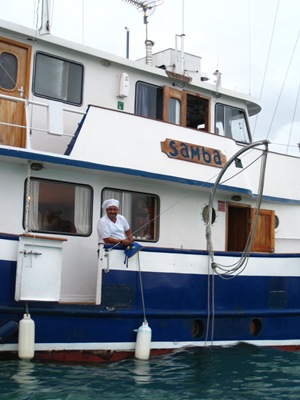
Slepak claims the Galapagos is one of his trips of a lifetime. After a week on a boat, I'd have to agree!  There is amazing wildlife and all the various islands are unique and interesting.  The only downside is it's not cheap.  I heard rumors of people getting 70% discounts going on standby though.  Sadly with funemployment having a fixed end date, I didn't have the schedule flexibility to try for a discount.  Instead I booked on the Samba - a lovely motor sailor which started life in Holland and now has an amazing Ecuadorian crew.  The highlight was definitely the chef, who ginned up some fabulous meals in a tiny kitchen:

IMG_8313

When most people think of the Galapagos, they think of tortoises.  One of our first stops was the Charles Darwin Research Station on Santa Cruz Island where two of the most famous of these guys live.  The first is Super Diego.  He was taken from the islands years ago and lived in the San Diego Zoo for decades.  About twenty years ago, the researchers started a breeding program and he came home to lend some genetic diversity to the cause.  To date he has some 1,000+ offspring!

IMG_8194

Lonesome George is the polar opposite of Super Diego.  Like Darwin's finches, each island has its own unique (sub) species, and George is the last of his line.  He's spent the last twenty years in big pen with two lovely young ladies originally from the island next to his (and thus genetically close) where the biologists hope he'll mate and keep the species alive.  Most days though he can't remember what to do with his girlfriends and instead just yells at the keepers when they don't arrange his lunch properly:

IMG_8248

Other things to do on Santa Cruz include trying to stuff yourself into a tortoise shell (slightly sacrilegious, don't tell anyone)

IMG_8294

And chasing after some of those finches.  It's impressive Darwin was able to tell them apart - sometimes it's just a slightly thicker beak that differentiates them.  The Golden Warblers aren't one of the fabled finches, but I think they're prettier:

IMG_8113

Other exciting birds we saw up close included Galapagos Hawks:

IMG_8754

Albatrosses doing some mating rituals:

IMG_8487

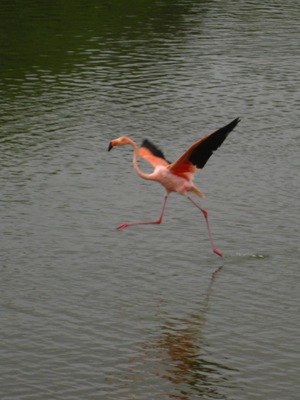
Flamingos:

IMG_8617

And of course, blue footed boobies!

IMG_9101

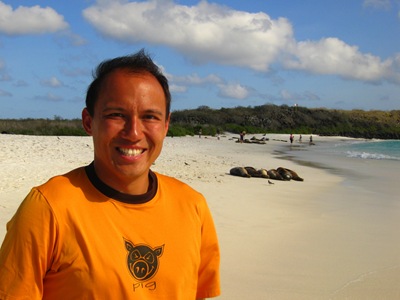
Each of the islands is different and unique.  Some have white sandy beaches:

IMG_8336

With sea lions enjoying the sun:

IMG_8416

Compacted ash makes for islands with wind eroded cliffs:

IMG_9073

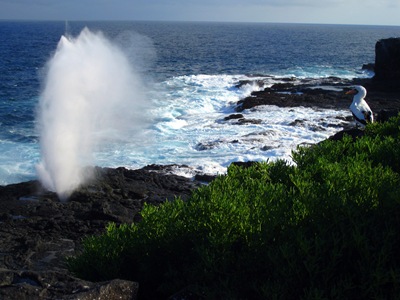
Others islands have rocky cliffs:

IMG_8493

With blowholes:

IMG_8524

And there are new islands covered in lava:

IMG_8632

And interesting cacti:

IMG_8587

Lots of different cacti - not something I really expected on tropical islands:

IMG_8046

My favorite type of animals were the iguanas.  "Marine" iguanas seem to spend a lot of time on land, mostly just lounging around:

IMG_8760

Land iguanas are a bit more photogenic:

IMG_8106 

The little lizards are also cool.  This one's on a bit of coral that was uplifted from the sea bed:

IMG_8714

Other random animal sightings included three lightfoot crabs fighting over a fish:

IMG_8840

And a pod of orcas:

IMG_8935 

I wrapped up the trip with some scenic vistas:

IMG_9145

And a gorgeous sunset!

IMG_9152